Linux OS namespace v/s container, pod and worker node
Namespace:
- mnt (Mount),
- IPC,
- net (Network),
- PID,
- user (user and group)
- and UTS (=Unix Time Sharing. Host name and domain name).
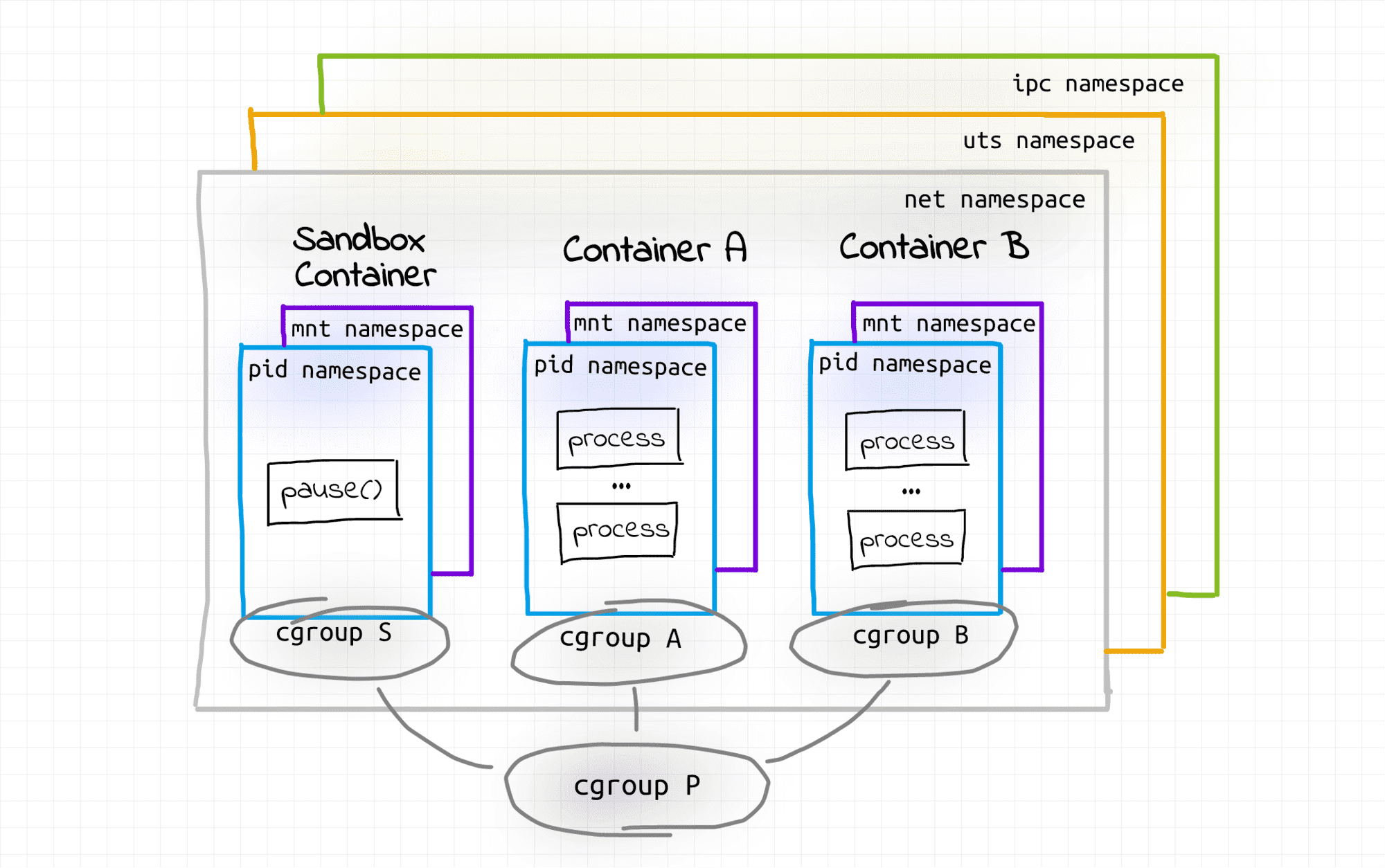
Within pod, each container have its own mnt space.
Within pod, each container may or may not have its own pid namespace, depending on value for shareProcessNamespace flag at pod specification.
Pause container has all 6 namespaces. Other container(s) having only pid and mnt namespace. They share net, uts, user and ipc namespace.
So containers within pod can communicate over
- Localhost IP: 127.0.0.1
- Shared domain name / host name
- IPC: shared memory, message queue etc.
- shareProcessNamespace
- hostPID
- hostNetwork
- hostIPC

- No. 0 is default case, We do not specify any flag. All four flags are set as false. So inside pod both container have its own pid namespace. Worker node has its own pid, net, ipc namespace.
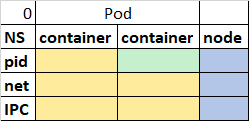
- No. 1 hostIPC = true. So pod (both container) and worker node share IPC namespace

- No. 2 hostNet = true. So pod (both container) and worker node share Network namespace. Usecase: CNI plugins related pod, ingress controller pod etc.

- No. 3 hostNet = true and hostIPC = true. So pod (both container) and worker node share Network namespace and IPC namespace
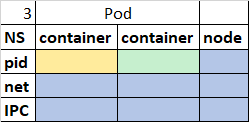
- No. 4 hostPID = true . So pod (both container) and worker node share PID namespace

- No. 5 hostPID = true and hostIPC = true. So pod (both container) and worker node share PID namespace and IPC namespace

- No. 6 hostPID = true and hostNet = true. So pod (both container) and worker node share PID namespace and Network namespace

- No. 7 hostPID = true, hostNet = true and hostIPC = true. So pod (both container) and worker node share PID namespace, Network namespace and IPC namespace

- No. 8 shareProcessNamespace = true. So both containers share PID namespace

- No. 9 shareProcessNamespace = true. So both containers share PID namespace. hostIPC = true. So pod (both container) and worker node share IPC namespace

- No. 10 shareProcessNamespace = true. So both containers share PID namespace. hostNet = true. So pod (both container) and worker node share Network namespace.

- No. 11 shareProcessNamespace = true. So both containers share PID namespace. hostIPC = true. hostNet = true. So pod (both container) and worker node share Network namespace and IPC namespace

- With CRI API spec, we can scope net, pid and ipc namespace at container level OR pod level OR node level. So, hypothetically, a pod where containers (within pod) cannot talk to each other via localhost can be constructed


11 Classification of Raag
- No Raag with all 12 notes
- No Raag with less than 6 notes.
- No Raag with two Re (Komal Re and Suddha Re)
- No Raag with two Dha (Komal Dha and Suddha Dha)
- There are Raag with two Ga (Komal Ga and Suddha Ga)
- There are Raag with Tivra Ma and Pa
- There are Raag with two Ni (Komal Ni and Suddha Ni)
- Every Raag must have either Ga, Ma or Pa
- No Raag with presence of Re, but absence of Pa
- No Raag with presence of Re + Kodmal Dha , but absence of Komal G
Nomenclature
- 0 Absent
- 1 Present
- <-> Ascent and vice versa in decent
- <- Decent


Musical Notes
Semi Tone:
1. GA-MA(E-F)
2. (NI-SA) (B-C): They are immediate switch
Minor Tone:
1. SA-RE (C-D). Here we skip one key : Komal G (D#, Eb)
2. RE-GA (D-E) . Here we skip one key : Komal RE (C#, Db)
3. MA-PA (F-G). Here we skip one key : TIVRA MA (F#, Gb)
4. (DHA-NI). Here we skip one key : Komal NI (A#, Bb)
| No. | Tone/SemiTone | Fy by SriNivas | Fy by Western | Fy By Manjarikaar | Linear scale | RASA Emotion | ||||||
|---|---|---|---|---|---|---|---|---|---|---|---|---|
| 1 | Do | C | So | Sa | S | षडज | कोमल स्वर Semi Tone | 240 | 240 | 240 | 240.0000 | RUDRA Anger |
| C# Db |
R1 | K-R | कोमल रिषभ | 259 1/5 259.2000 |
256 | 254 2/17 254.1176 |
254.2711 | |||||
| 2 | Re | D | R2, G2 | Re | R | रिषभ | शुद्ध स्वर Tone | 270 | 270 | 270 | 269.3909 | VIR Valor, courage |
| D# Eb |
R3, G1 | K-G | कोमल गंधार | 288 | 288 | 288 | 285.4097 | |||||
| 3 | Mi | E | G2 | Ga | G | गंधार | शुद्ध स्वर Tone | 300 | 301 17/43 301.3953 |
302.3811 | KRUPA & SHAANT, grace and peace | |
| 4 | Fa | F | M1 | Ma | M | मध्यम | कोमल स्वर Semi Tone | 320 | 320 | 320 | 320.3616 | HASYA, humor |
| F# Gb | M2 | T-M | तीव्र मध्यम | 344 8/143 344.0559 |
337.5 | 338 14/17 338.8235 |
339.4113 | |||||
| 5 | Sol | G | P0 | Pa | P | पंचम | शुद्ध स्वर Tone | 360 | 360 | 360 | 359.5937 | SHRUNGAAR , Romance |
| G# Ab | D1 | K-Dh | कोमल धैवत | 388 4/5 388.8000 |
384 | 381 3/17 381.1765 |
380.9763 | |||||
| 6 | La | A | D2, N3 | Dha | Dh | धैवत | शुद्ध स्वर Tone | 405 | 400 | 405 | 403.6303 | BIBHATS |
| A# | D3, N1 | K-N | कोमल निषाद | 432 | 432 | 432 | 427.6314 | |||||
| 7 | Si | B | N2 | Ni | N | निषाद | शुद्ध स्वर Tone | 452 4/43 452.0930 |
450 | 452 4/43 452.0930 |
453.0597 | BHAY & ___, fear and ___ |
| Do | C | Sa | S | 480 | 480 | 480 | 480.0000 |
Eye Exercises
1. simple effortless gazing for 30 to 35 seconds (Press and Release Palming.)
2. look at details, steady gaze at wick of the candle: size different colors (golden, orange, yellow. black at center). of flame (constant pressure Palming with breathing)
3. defocus flame. be aware about surrounding of flame, its aura etc. close eye and connect it to 3rd eye. ANTAR Trataka. Recollect all details of flame. (Palming with Bhramari) (make sanklpa for good vision)
5G Standards Development Update in 3GPP – Release 17 and 18
R17: Enhanced support for broadband & vertical use cases
R18: Advance technologies & applications, e.g. AI/ML, XR, high fy bands
R19: New vertical users, applications, deployment models, spectrum.
================================
1. Service and system aspects
- SA1: Service Requirements
- SA2: System Architecture
- SA3: Security
- SA4: Codecs and Media Handling
- SA5: Telecom Management
- SA6: APIs and Applications
2. CT = Core Network and Terminals
- CT1: Radio Application Protocols
- CT3: External Networking
- CT4: Core Network Protocols
- CT6: Smart Card Applications
3. RAN: Radio Access Network
- RAN1: Radio L1
- RAN2: Radio L2& L3
- RAN3: Radio N/w Interface
- RAN4: Radio Performance Aspects
- RAN5: Mobile Conformance Testing
================================
SA1 R17 (Service Requirements)
Majority of Work Area
- eCAV: Enhanced Cyber-Physical Control ( industrial / factory vertical)
- AVPROD: AV Service PRODuction ( A/V production vertical)
- ATRAC: Asset TRACking ( warehouse vertical)
- CMED: Critical MEDical applications ( medical vertical)
- EAV: UAV Enhancement ( drone vertical)
- 5GSAT: Satellites uses in 5G ( satellite vertical)
- REFEC: Enhanced Relays for coverage and energy efficiency ( various verticals)
- MUSIM: support for Multiple USIMs per UE
- NCIS: Network Controlled Interactive Service
Ref: TR 21.917 R17
SA1 R18 (Service Requirements)
Work Areas for Vertical Markets
- 5GSTAB: Satellite Backhaul ( satellite vertical)
- SVCS: Satellite Access for Video Surveillance ( satellite vertical)
- EXPOSE: Service Exposure for Verticals ( various verticals)
- LPHAP: Low Power High Accuracy Positioning ( industrial / factory vertical)
- SEI: Smart Energy & Infrastructure ( power grid vertical)
- 5TRS: Timing Resiliency Service ( various verticals)
R17 was for specific verticals. R18 was not for specific verticals except satellite and power grid like
- PIN/Pirates - Personal IoT Networks
- Resident/Pirates - Residential 5G Networks
- Ranging - UE Ranging Service and sidelink positioning
- AMMT - AI/ML model transfer (Network - UE)
- EASNAS - Enhancement to network slicing
- eMMTEL - IMS Evolution
- TACMM - UE tactile & multi-modal communication (gaming, robotic control)
- VMR - Vehicle Mounted Relays
- PALS: Access to Localized Network Service
- SFChain: Service Function Chaining
SA2 R15 (System Architecture)
Baseline NR functionality for eMBB & URLLC
SA2 R16 (System Architecture) 5G phase 2
SA2 R17 (System Architecture)
Expand market reach of 5G: Satellite, IoT, Public Safety and MCS (Mission Critical Services), Edge Computing & Interactive Cloud Services, UAS (unmanned Aerial Systems),
Addtional Req of mobile operators and verticals: Enhancement, Performance & effeiciency improvement, targeting industrial, V2X, mMTC, eMBB, N/w slicing and IAB ( Integrated Access Backhaul)
Edge Networking
- Since R15.uplink classifier or branching point
- 3 connectivity models
1. distributed anchor point
2. session breakout
3. multiple PDU session
- discovery of edge application server
- N/w info. provisioning to local applications with low latency. E,g, N/w congestion,
- Seamless edge relocation
- 3GPP application layer architecture support
- DNAI based (I-)SMF selection
By SA2 and SA6 both. Complementary solution.
SNPN (Standalone Non-Public Network)
R17:
- New Functions
- Credential Holder
- NSS-AAF (Network Slice Specific Authentication and Authorization Function. )
- UE onboarding & provisioning
- IMS voice
- Emergency Service
- Integration of IEEE TSN.
- Time Sensitive Communication Services
- Only DL Time Synchronization
- Time Synchronization
- Time Sensitive Communication for any application
- UL Time Synchronization also. TSN grandmaster clock can be at device also
- etc.
- N/W Automation and Data analytics by NWDAF
- NWDAF = AnLF (Analytics Logical Function) + MTLF (Model Training Logical Functoin)
- Distributed NWDAF
- Data collection coordination and delivery
- Supporting MA PDU with 3GPP access leg over EPC and Non-3GPP access leg over 5GC
- LRF: Location Retrieval Function
- GMLC: Gateway Mobile Location Center