Live AudioCast
Under Innovation Series "What an idea Sir-ji", I posted an idea about "Ad-hoc Amplifier". Today one more idea.
Innovation name: Live AudioCast.
Intent: Organize a live audiocast for any event across the globe, over Internet.
Context: Some times, we wish to involve, include our friends for some interesting event. It can be musical concert, inspirational speech or Satsang. Yes we can always call our friend and make him/her listen to. However if our friend is at abroad then ISD calls are expensive. Also, we can make call to one friend, we cannot share the audio with many friends at the same time.
Few years back, we Art of Living followers used to listen Guruji's knowledge CDs over Skype, from across the globe. One day, I arranged for live audiocast for Satsang at Art of Living Ashram in the presence of Guruji. We all across the globe were excited for this live audiocast.
Applicability: To address a group of people, across the globe. To share live excitement of some interesting event, such as musical concert, inspirational speech or Satsang etc.
Accessories:
* A pair of simple 2G mobile phone. (GSM or CDMA does not matter.)
* One mobile must have 3.5 mm audio out. (2.5 mm audio out is also fine with suitable adapter to convert it to 3.5 mm socket).
* An audio cable with 3.5 mm jack at both end.
* A laptop/desktop
* Internet Connection
* Skype software
Implementation:
* Connect the mobile phone A and computer with audio cable. Mobile out should go as microphone in to the computer.
* Make sure, computer is not using internal microphone. Audio is not mute. If one makes call, with mobile A then, remote party voice should come from computer speakers.
* The another mobile B should be at venue, where the interesting event is going on. Establish voice call between two mobiles. Make sure, mobile B is near speakers, under good audio condition, minimal ambient noise and minimal echo.
* Now, one can listen the live audio at computer speaker from the event at remote venue.
* Now, with this setup, if a person make VoIP Skype group call over Internet, then all participants can also enjoy the same audio.
Known Uses:
* This solution is useful particularly, when no Internet connection at the venue of the event. Yes 3G and now 4G wireless broadband is omnipresent, their cost is not always affordable.
* This solution can be implemented at rural area also, where there is no Internet connection, for some event about folk songs, folk story etc.
* Yes, this audio-cast need to be scheduled, in advance. The participants need to log in to Skype and one person must be present at the venue. If there are people with common interest, geographically distributed then this is a right solution. The group can be alumni students of a college having group voice call, where few friends have only 2G coverage. The group can also be a set of professionals working in the field without Internet connection for regular meetings.
Limitations:
* Over Skype group call maximum 32 participants can be join. So off course this is not a scalable solution.
* The end-user experience is adversely impacted in case of poor placement of mobile B at the venue with respect to audio speakers.
* All the participants have to mute microphone at their end.
* This is one way. If the participant wants make it interactive dialogue then, they are solely depend on people who organized this audio cast. (People who have mobile A and mobile B).
* VoIP calls are optimize for voice. So for music audio-cast, the call quality may not be upto the mark.
Future Scope:
* Yes, this solution can be improved if one can directly connect the audio system at the venue to the microphone in for the mobile.
* Also, one can find out Skype alternative, for scalable solution. May be one participant can cascade the call. He can make a call to other set of 32 participants using some other Skype like tool.
* We can make 3G / 4G video call between a pair of mobile and make live streaming webcast of the event with audio and video both.
* The same solution can be worked to make cheap ISD calls over VoIP. One needs to figure out cabling for full duplex channels. With this setup only one way simplex voice will be fine.
Related solutions:
Over the period of time, 3G and 4G will penetrate more area and its price will also down. In that case, it will be much easy and affordable to setup even live webcast (with audio and video both).
Many website including YouTube, allows streaming of live events. However it needs Internet connection at the venue.
Summary
So friends, many telecom professional thinks, VoIP means SIP and IMS only. Skype call is also VoIP call. They think, about some telecom products, switches, softswitch, with SIP protocol and complex feature / scenarios / Call-flows that have nothing to do with our day to day life. Just think again. One can connect any audio input to laptop/desktop in microphone socket, that audio can go over Skype call. Voice over IP. Even entry level basic mobiles have 2.5mm or 3.5mm audio out socket for hands-free. We just need a audio cable to make everything works.
We also think, live streaming always needs Internet at the venue. If not Internet then some V-SAT satellite link that only media channel posses. We can also have such simple setup with 2G GSM/CDMA technology.
Coming back to Art of Living. Nowadays, we have live streaming, audio + video webcast over YouTube for all the Satsangs, event (in Guruji's presence) across the globe. Even, one can access live transcript and / or live audiocast using his mobile phone. Further details at Art of Living website.
Stay tune to this innovation series "What an idea Sir-ji" for more such JUGAADs about applied science with limited resources.
Innovation name: Live AudioCast.
Intent: Organize a live audiocast for any event across the globe, over Internet.
Context: Some times, we wish to involve, include our friends for some interesting event. It can be musical concert, inspirational speech or Satsang. Yes we can always call our friend and make him/her listen to. However if our friend is at abroad then ISD calls are expensive. Also, we can make call to one friend, we cannot share the audio with many friends at the same time.
Few years back, we Art of Living followers used to listen Guruji's knowledge CDs over Skype, from across the globe. One day, I arranged for live audiocast for Satsang at Art of Living Ashram in the presence of Guruji. We all across the globe were excited for this live audiocast.
Applicability: To address a group of people, across the globe. To share live excitement of some interesting event, such as musical concert, inspirational speech or Satsang etc.
Accessories:
* A pair of simple 2G mobile phone. (GSM or CDMA does not matter.)
* One mobile must have 3.5 mm audio out. (2.5 mm audio out is also fine with suitable adapter to convert it to 3.5 mm socket).
* An audio cable with 3.5 mm jack at both end.
* A laptop/desktop
* Internet Connection
* Skype software
Implementation:
* Connect the mobile phone A and computer with audio cable. Mobile out should go as microphone in to the computer.
* Make sure, computer is not using internal microphone. Audio is not mute. If one makes call, with mobile A then, remote party voice should come from computer speakers.
* The another mobile B should be at venue, where the interesting event is going on. Establish voice call between two mobiles. Make sure, mobile B is near speakers, under good audio condition, minimal ambient noise and minimal echo.
* Now, one can listen the live audio at computer speaker from the event at remote venue.
* Now, with this setup, if a person make VoIP Skype group call over Internet, then all participants can also enjoy the same audio.
Known Uses:
* This solution is useful particularly, when no Internet connection at the venue of the event. Yes 3G and now 4G wireless broadband is omnipresent, their cost is not always affordable.
* This solution can be implemented at rural area also, where there is no Internet connection, for some event about folk songs, folk story etc.
* Yes, this audio-cast need to be scheduled, in advance. The participants need to log in to Skype and one person must be present at the venue. If there are people with common interest, geographically distributed then this is a right solution. The group can be alumni students of a college having group voice call, where few friends have only 2G coverage. The group can also be a set of professionals working in the field without Internet connection for regular meetings.
Limitations:
* Over Skype group call maximum 32 participants can be join. So off course this is not a scalable solution.
* The end-user experience is adversely impacted in case of poor placement of mobile B at the venue with respect to audio speakers.
* All the participants have to mute microphone at their end.
* This is one way. If the participant wants make it interactive dialogue then, they are solely depend on people who organized this audio cast. (People who have mobile A and mobile B).
* VoIP calls are optimize for voice. So for music audio-cast, the call quality may not be upto the mark.
Future Scope:
* Yes, this solution can be improved if one can directly connect the audio system at the venue to the microphone in for the mobile.
* Also, one can find out Skype alternative, for scalable solution. May be one participant can cascade the call. He can make a call to other set of 32 participants using some other Skype like tool.
* We can make 3G / 4G video call between a pair of mobile and make live streaming webcast of the event with audio and video both.
* The same solution can be worked to make cheap ISD calls over VoIP. One needs to figure out cabling for full duplex channels. With this setup only one way simplex voice will be fine.
Related solutions:
Over the period of time, 3G and 4G will penetrate more area and its price will also down. In that case, it will be much easy and affordable to setup even live webcast (with audio and video both).
Many website including YouTube, allows streaming of live events. However it needs Internet connection at the venue.
Summary
So friends, many telecom professional thinks, VoIP means SIP and IMS only. Skype call is also VoIP call. They think, about some telecom products, switches, softswitch, with SIP protocol and complex feature / scenarios / Call-flows that have nothing to do with our day to day life. Just think again. One can connect any audio input to laptop/desktop in microphone socket, that audio can go over Skype call. Voice over IP. Even entry level basic mobiles have 2.5mm or 3.5mm audio out socket for hands-free. We just need a audio cable to make everything works.
We also think, live streaming always needs Internet at the venue. If not Internet then some V-SAT satellite link that only media channel posses. We can also have such simple setup with 2G GSM/CDMA technology.
Coming back to Art of Living. Nowadays, we have live streaming, audio + video webcast over YouTube for all the Satsangs, event (in Guruji's presence) across the globe. Even, one can access live transcript and / or live audiocast using his mobile phone. Further details at Art of Living website.
Stay tune to this innovation series "What an idea Sir-ji" for more such JUGAADs about applied science with limited resources.


Verbs in Sanskrit (धातुरूपनन्दिनी)
This article is about verbs in Sanskrit, based on a book धातुरूपनन्दिनी DHATURUPNANDINI by Janardan Hegade. Reader needs basic knowledge of DEVANAGARI script to read this article.
What is a sentence? It is nothing but, group of तिडन्त and सुबन्त words. तिडन्त words are verbs that ends with ति etc. सुबन्त words are nouns that have विभक्ति प्रत्यय. Generally most of the nouns (सुबन्त words) have came from धातु verbs only. So in Sanskrit verbs धातु are most important.
Tense
So let's start our verbs study with tense. Verbs are known as लकार in Sanskrit. There are 10 लकार. We add vowels to ल and then add ट or ड़ So they are
लट् , लिट् , लुट् , लृट्, लेट् , लोट् ,
लङ् , लिङ्, लुङ् and लृङ् No लेङ् , no लोङ् लकार in Sanskrit. Only 10.
Out of this 10 tenses, लेट लकार is used only in वैदिक literature. So no need to study, for day to day Sanskrit conversation. 10 - 1 = 9. However लिङ् लकार has 2 subtypes. आशी लिङ् and विधि लिङ् So 9 + 1 = 10. लट् , लिट् , लुट् , लृट्, लोट् , लङ् , आशी लिङ्, विधि लिङ्, लुङ् and लृङ्
As we know, mainly there are 3 tense only. Present tense, past tense and future tense. The present tense, now, is like non-existing. The moment you speak, now, that time instance has gone. Present tense is लट् लकार. Sanskrit has अद्यतन काल That applies to any today's event, where today is define as midnight to midnight. अद्यतन future tense (लृट् लकार) and अद्यतन past tense (लङ् लकार). Beyond 24 hours is नअद्यतन or अनद्यतन . अनद्यतन past tense (लुङ् लकार) and अत: future tense (लुट् लकार). अनद्यतन past tense is used for event, that is not so ancient. Sanskrit has परोक्ष tense also. This is for event that we have not seen. परोक्ष past tense (लिट् लकार) is used for describing ancient time, mythological stories etc. Future tense, no one has seen, so it is always परोक्ष. So Sanskrit language has not परोक्ष future tense.
So let me summarize, we have 3 past tense. अद्यतन past tense (लङ् लकार), अनद्यतन past tense (लुङ् लकार) and परोक्ष past tense (लिट् लकार). We have 1 present tense लट् लकार. 2 future tense: (लुट् लकार) अत: or अनद्यतन future tense and अद्यतन future tense (लृट् लकार ). 3 past + 1 present + 2 future = 6 tenses.
Remaining 4 tenses. (1) लोट् लकार for request or order (आज्ञा) लोट् लकार never used for possibility. (example भवतु) (2) विधि लिङ् for rituals, invitation, prayer, possibility etc. (example भवेत् )(3) आशी लिङ् (example भूयात्) This one is most difficult one. So let's leave it. Anyway, instead of आशी लिङ् one can always use लोट् लकार (4) लृङ् लकार It is combination of past and future tense with cause and effect relationship. (example अभविष्यत्)The activity is not done/completed. It has effect of past tense. For example, if Krishna would not have preach Bhagvad Gita, Arjun would not have fight the battle.
महर्षि पाणिनि suggested to use only one past tense. लुङ् लकार, अनद्यतन past tense for both परोक्ष past tense (लिट् लकार) and अद्यतन past tense (लङ् लकार). Also for future tense instead of लुट् लकार, अत:or अनद्यतन future tense, only use लृट् लकार, अद्यतन future tense. Let's further simplify it.
महर्षि पाणिनि suggested to use लुङ् लकार for past tense, but लुङ् लकार is difficult. So in day to day life, (लङ् लकार) is popular for past tense, regardless of today's past event or any past event. महर्षि पाणिनि is सूत्रकार He gave so many formulas for grammar. If वाक्यकार (example Kalidas) has different opinion than सूत्रकार, then वाक्यकार is valid. If भाष्यकार (example Mallinath) has has different opinion than वाक्यकार , then भाष्यकार is valid. However, in Sanskrit, शिष्ट व्यवहार has the highest authority.
Adaagam अडागम
अडागम is special character अ is prefixed for verb for 3 tenses. (1) लङ् लकार (2) लुङ् लकार and (3) लृङ् लकार. First let's see the complexity, added by अडागम, latter we will look at the alternative simple solutions.
For Sanskrit verbs, उपसर्ग: is also prefix. 50% of verbs used in day to day, Sanskrit conversation contains उपसर्ग: Now, this अडागम enters just before verb, then उपसर्ग is placed. So from left to right, first उपसर्ग then अडागम and then the verb धातु. So this involves complex rules of (1) स्वर संधि (2) व्यंजन संधि and (3) विसर्ग संधि for (1) लङ् लकार (2) लुङ् लकार and (3) लृङ् लकार. Many times वृद्धि संधि also happens. Here खलो कपात न्याय is applicable. Means all rules are evaluated and whichever rules are applicable, they are applied.
Here is simple solution. लङ् लकार we can replaced with क्तवतु प्रत्यय (गतवान् etc). लुङ् लकार, we have already skipped. Instead of लृङ् लकार, we can use स्यात, स्यु:, स्याम etc. We cannot make it further simplified. :)
Group (गण)
We have total 9 words (forms / रूप रूपाणि ) for each tense. First person (उत्तम पुरुष), Second person (मध्यम पुरुष) and third person (प्रथम पुरुष) + singular (एक वचन ) , 2 (द्वि वचन ) and plural (बहु वचन). So each tense has total 9 suffix, which are added at the end of verb (धातु) to indicate person and singular/plural. They are called आख्यात प्रत्यय Before adding this suffix, आख्यात प्रत्यय, one more suffix is added that is विकर्ण प्रत्यय. This विकर्ण प्रत्यय is specific to group (गण). Each verb belongs to specific group. विकर्ण प्रत्यय is applicable to 4 लकार (tense) and 2 प्रत्यय . 4 लकार (1) लट् (2) लोट् (3) लङ् and (4) विधि लिङ् and 2 प्रत्यय (1) शतृ प्रत्यय and (2) शानच प्रत्यय These 4 लकार are called सार्वधातुका: and remaining 6 लकार are आर्धधातुका:
How महर्षि पाणिनि did this grouping? Simple guideline: All the verbs who have some similarity should belong to single group. We also make group of people like (1) ladies and gentlemen 2 groups, (2) age-wise group, (3) native place wise group etc. What is that similarity for verbs? Just notice their forms (रूपाणि ) for above 4 लकार (tense), if the have some common specific विकर्ण प्रत्यय, then they belong to that specific group (गण). So one should know, the usage of all verbs in day to day life, to identify the verb's membership to specific group. Other way is also true. If one knows the verb's group then he can make grammatically correct usage of that verb.

How महर्षि पाणिनि did this grouping? Simple guideline: All the verbs who have some similarity should belong to single group. We also make group of people like (1) ladies and gentlemen 2 groups, (2) age-wise group, (3) native place wise group etc. What is that similarity for verbs? Just notice their forms (रूपाणि ) for above 4 लकार (tense), if the have some common specific विकर्ण प्रत्यय, then they belong to that specific group (गण). So one should know, the usage of all verbs in day to day life, to identify the verb's membership to specific group. Other way is also true. If one knows the verb's group then he can make grammatically correct usage of that verb.
Sanskrit language has approximately 2000 verbs. They are grouped under 10 गण. Almost 50% of verbs belongs to first गण. Its name is भ्वादि: . Its विकर्ण प्रत्यय is 'अ'. The 6th (name तुदादि:) has only 157 members. Its विकर्ण प्रत्यय is also 'अ'. The 8th गण (name तनादि:) has only 10 verbs. The 7th गण (name रुधादि:) has typical विकर्ण प्रत्यय 'न' . This विकर्ण प्रत्यय 'न' is not suffix. It enters just before last character of the verb. Like kids prefer to jump compound wall to enter to school, even the gate is open ! :) For example रुध धातु, न is added, so it becomes रुनध then रुणध.
Do you know, these 10 groups have also internal grouping. गण 1, 4, 6 and 10 forms one group. They all have विकर्ण प्रत्यय that ends with vowels. So their धातु रूपाणि are relatively simple. These 4 गण study was part of our 8th standard school syllabus. Remaining 6 गण are little difficult, that we studied in 9th standard.
In addition to these 10 groups (गण), two more groups are popular. As we know, they are (1) परस्मैपदी and (2) आत्मनेपदी. सम verbs belong to both of these groups. They are (3) उभयपदी. So in Sanskrit, each verbs belong to any one गण out of 10 गण and also any one group out of the above 3 groups. It is like 2 dimension array. The former membership decide विकर्ण प्रत्यय for the 4 लकार (tense) and 2 प्रत्यय and the later one decide आख्यात प्रत्यय. Off course आख्यात प्रत्यय also depends on लकार
3 rules for all tense (लकार)
Now apart from this 10 groups' विकर्ण प्रत्यय, there are 3 major rules that applies to all the 10 tense (लकार)
In addition to these 10 groups (गण), two more groups are popular. As we know, they are (1) परस्मैपदी and (2) आत्मनेपदी. सम verbs belong to both of these groups. They are (3) उभयपदी. So in Sanskrit, each verbs belong to any one गण out of 10 गण and also any one group out of the above 3 groups. It is like 2 dimension array. The former membership decide विकर्ण प्रत्यय for the 4 लकार (tense) and 2 प्रत्यय and the later one decide आख्यात प्रत्यय. Off course आख्यात प्रत्यय also depends on लकार
3 rules for all tense (लकार)
Now apart from this 10 groups' विकर्ण प्रत्यय, there are 3 major rules that applies to all the 10 tense (लकार)
- इदित धातु: (1) स्कुदि (2) वदि (3) कपि etc. verbs ends with इ. Here, इ is replaced with न् . We often speaks वन्दे मातरं. Here the original verb धातु is वदि. इ is replaced with न्. So वदि becomes वन्द. ए is added for आत्मनेपदी First person (उत्तम पुरुष), singular (एक वचन ) present tense (लट लकार) So वन्द becomes वन्दे. Such इदित धातु are not always आत्मनेपदी. Not necessary. Even we can group all the verbs based on their last character. Another way of grouping....
- ष is replaced with स . For example ष्वद verb's forms (रूपाणि) contains स instead of ष
- ण is replaced with न. For example णम verb's forms (रूपाणि) contains नम.
धातुरूपनन्दिनी
For each गण and its विकर्ण प्रत्यय , please refer the book धातुरूपनन्दिनी (ISBN 978-81-87276-67-3) This book contains forms for all 10 tense for all approx 2000 verbs. Obviously for all 10 tenses, all 9 forms are not given, just one form is given for third person singular ( प्रथम पुरुष एक वचन ), so remaining forms we can easily derive. Yes, for typical verb, special case, all 9 forms are given. In addition to that, for each verb (1) its membership to group (गण), and परस्मैपदी , आत्मनेपदी, उभयपदी is mentioned. (2) सेट , वेट & अनिट (3) णिची (4) सनि (5) भावे and (6) यकि forms रूपाणि are captured.

Generally, one is excited for such book at the beginning. Later on, it remains unused. So Janardan Hegade, provided guidance about how to use this book. One should daily write all the forms (रूपाणि ) of all 10 tenses for at least one verb. Do not try to remember, just see the book and write. It will really make you master of Sanskrit verbs. This book is like dictionary. One can refer it whenever needed. The author also showed various other books for reference and compare them.
Thanks
I am thankful to Gauri Rao, PV Parameswaran, Shiva Kumar Kotikalapudi, Dev and N S Lakshmanan for their appreciation and encouragement for this article. I am also thankful to SriKanth, Usha Gopalakrishnan,Chandrasekaran and Sunil Kumar for appreciation and promoting YouTube video. Special thanks to Prashanth V, who helped to type few typical Devanagari character.
Thanks
I am thankful to Gauri Rao, PV Parameswaran, Shiva Kumar Kotikalapudi, Dev and N S Lakshmanan for their appreciation and encouragement for this article. I am also thankful to SriKanth, Usha Gopalakrishnan,Chandrasekaran and Sunil Kumar for appreciation and promoting YouTube video. Special thanks to Prashanth V, who helped to type few typical Devanagari character.
Disclaimer:
- I have written this article based on my understanding of a day long session by Janardan Hegade. I may have misunderstood, misinterpreted some point. Please let me know any correction.
- This article is not verbatim of Janardan Hegade's session.
- For more details please refer the videos at YouTube. You will find many more details, that are not covered in this article.
These YouTube videos (playlist) contains 3 topics (1) verbs DHATU (2) SAMAAS (3) VIBHAKTI. This article only covers verbs DHATU. For other topics, stay tune this blog Express YourSelf !
Sudarshan Kriya is like GPS
This article describes the insight to interpersonal relationships.
Today GPS technology is accessible to most of us on our smartphones. The GPS helps us to know where we are in relation to other people and places. The navigation softwares guide us while driving to reach our destination.
As we all know our existence has seven layers. Body, Breath, Mind, Memory, Intellect, Ego and Self.
Most of the time ego is the root cause for interpersonal issues. Ego is like complex interwoven blend of our desires (mind), value system and belief (intellect), past life (memory) and our self-concept. If two parties communicate at different level of existence then conflicts may arise. How nice if we can build a GPS, that tells us, the location of other person vis-a-vis our location on these seven layers of existence. It is easy.
Generally, body-builders, filmstars, models, teenagers, Yoga professionals are more body conscious. Ambitious people, teenagers, politicians and under privileged people may have many desires and dreams. Few people have strong impression about their childhood. Old people also most of the time think about their past glory or miseries. Professionals and well – educated people are very intelligent. They always seek, logic behind every action, rituals, and traditions. They may also have judgmental and fault finding attitude. The emotional people are more fragile. They may get hurt very easily. Many times egoistic people are result oriented. It is difficult to motivate lazy people.
We know all these. Yet, generation gap exists. Sometime, we do some common mistakes like,
1. We use logic, reason and past events to prove others’ mistake. The other party at ego level, defensive mode. We are at memory and intellect level. People feel very difficult to give explanations about his/her actions. The true nature of self is to be witness, not the doer.
2. We talk about faith, religion, God, rituals to intellectual people. We are at emotional level and they are at intellect level.
3. Many times kids demand toys etc. to parents. Kids are at mind level and parents are at intellect level.
4. We rarely spare time with our parents and grandparents to listen to their life struggle. They are at memory level, we are at intellect level.
5. We make some joke, comment about other person, which is completely opposite to his/her own self concept and value system. It can deeply hurt his ego if he does not take it lightly.
6. The youth demand logic behind some religious rituals, without any respect to our ancient sages, who have established such traditions. They are at intellect level, elders at emotional level.
7. As parents we rarely take interest in upcoming trends like Facebook, Twitter etc. We firmly believe social media is useless nuisance of new age. We are at intellect, memory and ego level.
The conflicts are not always bad. All such conflicts make us stronger. However, we can avoid unnecessary conflicts, if we use GPS to know our location and others’ location on these seven layers. It is much more easier to modify our behavior first and then influence others. GPS helps us to quickly identify, at this moment, what other party may be thinking. Which layer is dominating. Even elders have this skill to some extent.
If other person is at
1. Ego level, then agree to him/her.
2. Memory level then bring him to enjoy the present moment or listen to him with full patience and interest.
3. Intellect level, then just indicate possibility of scientific reason.
4. Emotional level then do not talk logic.
5. Mind level with strong desire then....you yourself find out the answer.
Always remember that this location keeps changing. We should come out of stereotypes. People are not always egoistic, always emotional neither always intelligent. Even our own opinions keep changing. We rarely come across intelligent people like nuclear scientists, or terrorists or mad people. We meet common men in our day to day life. The common men are by and large good people.
Have you noticed? We never have any conflicts with kids and enlightened masters. They are at self, inner most layer. Kids are always enthusiastic and ever smiling without any reason. The enlightened masters have only one desire, to divert all people to the divine as per their individual interest. So people come out of ignorance and enjoy true joy of the inner being.
If we focus on breath then it can be much easier to become aware and apply GPS. Sudarshan Kriya is such a technique. The Sudarshan Kriya moves us to all the layers and introduces us to the new terrain and hidden places, blockages, possibilities and potentialities. Then it brings us to the core part. Self, love, peace, purposeless enthusiasm. That is Art of Living.
About motivation, already many books are written. Greedy people are motivated by money. Fearful people by some threat. Egoistic people by some challenge. Love motivates all. So let's stay at core part. Self, Love, Peace Atma, Spirit.
With awareness, one can move from outer layers to innermost Self level.
You can also refer my earlier article "Express YourSelf !", to know more about seven layers. You may also like "Music of Mind", where I have explained Sudarshan Kriya with mathematics.
Today GPS technology is accessible to most of us on our smartphones. The GPS helps us to know where we are in relation to other people and places. The navigation softwares guide us while driving to reach our destination.
As we all know our existence has seven layers. Body, Breath, Mind, Memory, Intellect, Ego and Self.
Most of the time ego is the root cause for interpersonal issues. Ego is like complex interwoven blend of our desires (mind), value system and belief (intellect), past life (memory) and our self-concept. If two parties communicate at different level of existence then conflicts may arise. How nice if we can build a GPS, that tells us, the location of other person vis-a-vis our location on these seven layers of existence. It is easy.
Generally, body-builders, filmstars, models, teenagers, Yoga professionals are more body conscious. Ambitious people, teenagers, politicians and under privileged people may have many desires and dreams. Few people have strong impression about their childhood. Old people also most of the time think about their past glory or miseries. Professionals and well – educated people are very intelligent. They always seek, logic behind every action, rituals, and traditions. They may also have judgmental and fault finding attitude. The emotional people are more fragile. They may get hurt very easily. Many times egoistic people are result oriented. It is difficult to motivate lazy people.
We know all these. Yet, generation gap exists. Sometime, we do some common mistakes like,
1. We use logic, reason and past events to prove others’ mistake. The other party at ego level, defensive mode. We are at memory and intellect level. People feel very difficult to give explanations about his/her actions. The true nature of self is to be witness, not the doer.
2. We talk about faith, religion, God, rituals to intellectual people. We are at emotional level and they are at intellect level.
3. Many times kids demand toys etc. to parents. Kids are at mind level and parents are at intellect level.
4. We rarely spare time with our parents and grandparents to listen to their life struggle. They are at memory level, we are at intellect level.
5. We make some joke, comment about other person, which is completely opposite to his/her own self concept and value system. It can deeply hurt his ego if he does not take it lightly.
6. The youth demand logic behind some religious rituals, without any respect to our ancient sages, who have established such traditions. They are at intellect level, elders at emotional level.
7. As parents we rarely take interest in upcoming trends like Facebook, Twitter etc. We firmly believe social media is useless nuisance of new age. We are at intellect, memory and ego level.
The conflicts are not always bad. All such conflicts make us stronger. However, we can avoid unnecessary conflicts, if we use GPS to know our location and others’ location on these seven layers. It is much more easier to modify our behavior first and then influence others. GPS helps us to quickly identify, at this moment, what other party may be thinking. Which layer is dominating. Even elders have this skill to some extent.
If other person is at
1. Ego level, then agree to him/her.
2. Memory level then bring him to enjoy the present moment or listen to him with full patience and interest.
3. Intellect level, then just indicate possibility of scientific reason.
4. Emotional level then do not talk logic.
5. Mind level with strong desire then....you yourself find out the answer.
Always remember that this location keeps changing. We should come out of stereotypes. People are not always egoistic, always emotional neither always intelligent. Even our own opinions keep changing. We rarely come across intelligent people like nuclear scientists, or terrorists or mad people. We meet common men in our day to day life. The common men are by and large good people.
Have you noticed? We never have any conflicts with kids and enlightened masters. They are at self, inner most layer. Kids are always enthusiastic and ever smiling without any reason. The enlightened masters have only one desire, to divert all people to the divine as per their individual interest. So people come out of ignorance and enjoy true joy of the inner being.
If we focus on breath then it can be much easier to become aware and apply GPS. Sudarshan Kriya is such a technique. The Sudarshan Kriya moves us to all the layers and introduces us to the new terrain and hidden places, blockages, possibilities and potentialities. Then it brings us to the core part. Self, love, peace, purposeless enthusiasm. That is Art of Living.
About motivation, already many books are written. Greedy people are motivated by money. Fearful people by some threat. Egoistic people by some challenge. Love motivates all. So let's stay at core part. Self, Love, Peace Atma, Spirit.
With awareness, one can move from outer layers to innermost Self level.
More Light on Less Known – 2
Acharya Ratnananda has unique blend of scientific temper along
with knowledge about Indian heritage. The same reflects in his book “More Light
on Less Known part 2” that highlights applied science from Vedas. The book discusses
many aspects of life like love, concepts, truth, logic, law, astrology, Vaastu, sentiment, wisdom, devotion, salvation and
so on. He invites all the readers to explore the journey of life, with
curiosity. Learn from past mistake and build on future hope. Be confidence yet
cautious.
The book starts with a prayer from Upnisada : “Grant us glow of attraction, the wealth of virtues and the power to win.” We want to win as many people and as long as possible in
physical or metaphysical spheres. Success is money, power, position to win
people. Love leads us to ultimate success.
Stories
Mythologica stories from Indian History may have less fact
and more imagination, but they are full of ancient knowledge that is applicable
even today. Purana has 150,000 stories in 6 divisions. They are gathered under
project “Tales for young and old”. The lessons from such tales are listed here. Few stories are in context of ancient Ashram (Gurukul), a
master, disciples, their interactions, tests and ends with beautiful pearls of
wisdom. Even one chapter explains difference between disciple and devotee.
- The master is path to our destination, but not destiny. He gives us true vision. We all share the master and none of us can secure Him only for oneself. He is within us, we need to realize it.
- The master represent both creator and creation. So if one comes to the master, he can gain real knowledge beyond books and real love that sprouts from gratitude.
- Duryodhan could not find any good person and Yudhishthir could not find any bad one. Wisdom blossoms, when we find a spark of virtue in everything. One can progress faster with positive attitude.
- A person who is at peace with himself and the world, full of faith in the master and love for mankind, need not run after enlightenment. Enlightenment will run after him.
- Lord’s name can do wonders beyond our imagination. It working is subtle and sublime.
- Brahma Vayvartha Purana explains shuttle meaning of the Lord Krishna’s birth.
- God helps those who help themselves.
- Shiva Purana has a nice story about 5 types of fools.
- All problem arise because we feel that life is quite long, though we see death all around us everyday.
- Katho-upanishad narrates famous story of Nachiketa.
- As per Maharshi Chandilya, knowledge carries us only half way to bliss. Love can transport us through other half. Knowledge coupled with love culminates in enlightenment. It is very essential to possess knowledge without falling into trap of ego and also to serve people with love and humility. The grace of the Master is also necessary.
- The realised souls avoids contact with vulgarity, not out of fear, but out of desire to keep away from impurity, though they are strong enough to destroy the impurity.
Health
Our body has most complex systems. 72,000 nerves. Heart that
beats 2.5 billion times in 60 to 70 years. Lungs intakes 10,000 litter air per
day. The author compares various medicines and how eastern medicines are the
best. Ayurveda (in North India) by sage Dhanvantri and Siddha (in South India) by
Maharishi Agasthya have many commonalities. Both cure illness rather
suppressing symptoms. Both recognize 3 Gunas
that affect mental state and both depend on 3 Dosa diagnosis. As per Ayurveda there are only 8 basic ailments. Both produce 3 forms of drugs powder, paste and oil
using herbs, minerals and metals. Anu Tailam (Atmoic Fluid), Argam, Haritaki, garlic, onion, Pancha Deepagni food suplement etc are some of the unique medicines in Ayurveda/Siddha. As per Maharsishi Punarvasu food is the best
medicine, both preventive and curative. Nowadays we lost habit for proper food
in right quantity at right time. Yoga is much more than physical exercises
(Asana). Pranayama (breathing exercise) is drugless remedy for most of our
illness. Avvaiyar was incarnation of Goddess Saraswati. She composed Tamil poems, which have gross and subtler meaning for "reversal of aging" technique.
Art of Living
Most of the time, either we try to impress others or we are
impressed by others. We should also look in. We can make ourselves as a perfect
specimen of Nature. This is Art of Living. It guides us to find pleasing approach to life. There are only 3 basic values in the world. Value of life, knowledge and justice. Human values involve blending of life with love, knowledge with experience and justice with compassion. The author dedicated few chapters for
his son (by birth) Sri Sri Ravishankar and Art of Living. He described him as a modern Messiah and
lists out though provoking words by the master.
History
The chapter "The Great March" is about history. India recognized Germany's greatness in distant past. Indian people reached there and addressed local people as Sharmanya (the wise ones). This term inn course of centuries become "Germany". Indian found a country covered with white snow and gave name "Sweta Desa". This term slowly become "Sweden". Even today many names in Sweden and Germany revel its Sanskrit connections like "Vastra, Viveka, Swastika, Kalburga" etc. As per modern German researchers, Jesus Christ came to India in very young age and studied Indian scriptures for 15 years. There are edicts and monuments in Kashmir to prove this.
Number Game
As per sage Anandi 5 steps for fulfillments are : Gyan, Dhan, Dharm, Karm and Tapsya. We face many situations throughout our life. We need to face them with calmness and detachment instead of worry and anxiety. As per Maharishi Agasthay 5 steps for success are Vastra (your dressing). Vapusha is how you carry yourself with poise, presentability, dignity etc. Vacha (speech). Be good listener. Manage to say more YES and less NO. Vidya: Proper homework before expressing/exposing yourself. Vinaya (humility). As per Saint Saraswati, 4 kinds of Happiness. Priya is when the object is at distance. Moda, when one comes to closer proximity. Pramoda: a sense of possession. Ananda is joy of giving - the ultimate one. Various sages have contributed for 6 validations. They are Nyaya, Vaisheshika, Sankhya, Yoga, Karma Mimamasa and Vedanta. 5 varieties of heat generating devices in our metabolism, for equilibrium of 3 dosa. They are Prana, Apana, Vyana, Udana and Samana. Ayurveda Samhitas prescribe foods for pregnant women.
The author describes the present situation of Indian Rural
women. They are economically poor, but spiritually rich. Their beliefs,
challenges, responsibility, needs etc. are covered in a chapter.
Uragapura (Sojourn of snakes) is a tiny village with natural beauty and peaceful atmosphere, just one hour away from Bangalore.
As per Dr. Tony Nader, Vedas are the blue print of all creation. Quantum physics speaks language of Upnishida.
As per Atharva Veda, while sleeping one should keep his head to south or east direction. Acharya Ratnananda has explained the scientific reason for it. Avoid daytime sleep. Let the dinner be light and early. Repeat few mantras to relax your mind before sleep.
Quotations
The book has many nice quotations. Some of them I liked very much:
- Your words should be such that they create silence in the mind of others.
- Give Charity if you can, if not, At least be charitable in attitudes.
- Reputation is the value that others give to you; but Honour is the value that you give to yourself.
- Our chef prepare novel varieties of food and our doctors discover newer varieties of sickness.
- Modern science has reduced pressure on muscles through more machines & increased pressure on nerves through more tension.
- The heart is very small, but the emotions it produces are very big.
Geeta Jayanti
Please mark your calendar. This Sunday 11th Dec 2011, join for Geeta Jayanti celebration. Organized by Samskrit Bharati. All are welcome. For the details, have a look to this pamphlet. So.... See you all there....


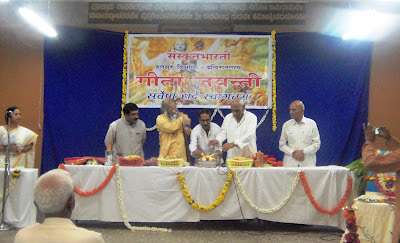


click here for complete Video Report for the event.